
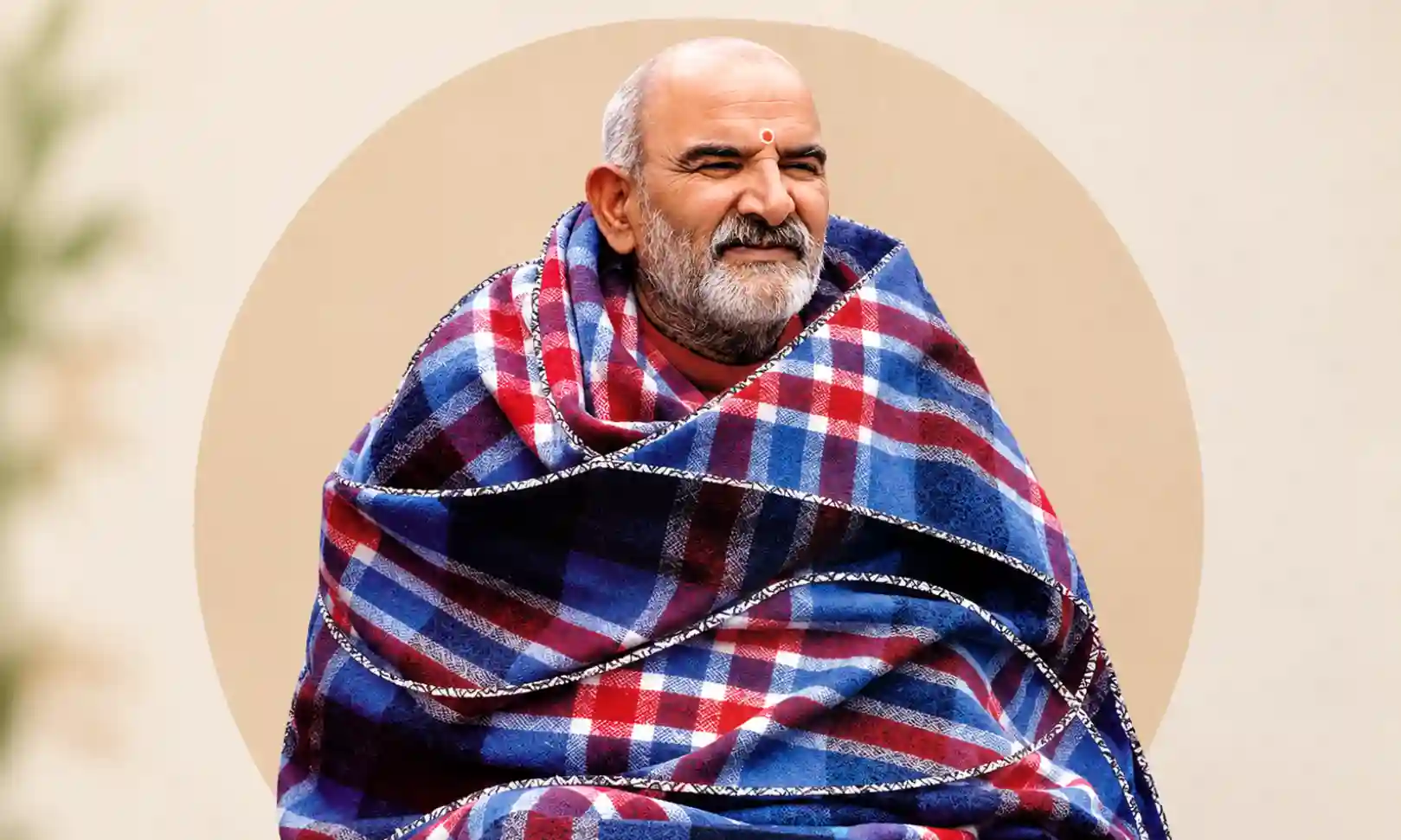
In the 1960s and 1970s, as a generation of seekers from the West traveled down the dusty paths of northern India searching for something more than mere materialism, they came across a humble mystic draped in nothing but a humble plaid blanket. Comfortably ensconced in a wooden cot (takhat) nestled between the foothills of the Himalayas, he never delivered a lecture, wrote any books, nor asked anything of anyone except money and institutional subservience. However, Neem Karoli Baba—whom his disciples affectionately referred to as Maharaj-ji—was destined to change the consciousness of the spiritual world forever.
From inspiring Dr. Richard Alpert of Harvard University to become the world-famous Ram Dass (of Be Here Now fame) to motivating world-class kirtan singer Krishna Das and humanitarian Larry Brilliant, and finally becoming a posthumous spiritual mentor of high-profile tech innovators Steve Jobs and Mark Zuckerberg, the impact of Maharaj-ji spans the globe. His entire teaching eschewed complicated dogma, being summed up instead by a very straight forward and challenging statement: “Love everybody, serve everybody, feed everybody, and remember God.”
Below follows the full biography of Neem Karoli Baba: life history, family tree, birth and death dates, miracles, ashrams, worldwide influence, and wise sayings.
Quick Facts About Neem Karoli Baba
| Quick Fact | Details |
| Birth Name | Lakshman Narayan Sharma |
| Revered Titles | Maharaj-ji, Baba Lakshman Das, Handi Wale Baba, Chamatkari Baba |
| Date of Birth | Circa 1900 |
| Date of Mahasamadhi (Death) | September 11, 1973 (1:15 AM) |
| Birthplace | Akbarpur Village, Firozabad District, Uttar Pradesh, During British India |
| Place of Mahasamadhi | Vrindavan, Uttar Pradesh, India |
| Parents | Father: Durga Prasad Sharma Mother: Kausalya Devi |
| Spouse | Smt. Ram Beti Sharma (Shubhshri) |
| Children | Son: Anek Singh, Dharm Narayan Sharma Daughter: Girija Devi |
| Core Spiritual Path | Bhakti Yoga (Devotion to Lord Hanuman & selfless service) |
| Primary Ashrams | Kainchi Dham (Nainital, Uttarakhand) & Vrindavan Ashram (Uttar Pradesh) |
| Notable Disciples & Followers | Ram Dass, Krishna Das, Bhagavan Das, Larry Brilliant, Jai Uttal, Dada Mukerjee |
| Prominent Global Visitors | Steve Jobs, Mark Zuckerberg, Julia Roberts, Jeffrey Skoll |
| Samadhi Shrine | Neem Karoli Baba Samadhi Mandir, Vrindavan, India |
Who Is Neem Karoli Baba?
The Neem Karoli Baba was an Indian saint, yogi, and devotee of Lord Hanuman who lived an example of Bhakti Yoga (devotion) and Seva (service) through his life. Free from any traditional religious structures, he wandered around northern India for many years and finally built up ashrams and Hanuman temples which attract thousands of pilgrims from all over the world nowadays.
The Maharaj-ji did not need any splendor. He never called himself an avatar, never allowed anyone to touch his feet in worship, and always sent all kinds of respect to Lord Hanuman. Wearing just simple dhoti made of cotton and a woolen shawl, living free from any property at all, he treated princes, politicians, peasants, and foreign visitors with the same love.
Neem Karoli Baba Birth and Death Date (Mahasamadhi)

Date of Birth (Circa 1900)
Neem Karoli Baba was born in a rich, highly religious Sanadhya Brahmin family of Akbarpur Village of present-day Firozabad District of Uttar Pradesh State. Though there is no formal registration of births in villages in those times, there is historical evidence which places his birth in or around the year 1900.
Date of Death / Mahasamadhi (September 11, 1973)
Neem Karoli Baba attained his mahasamadhi (left his physical body) early in the morning of September 11, 1973 at about 1:15 AM IST in a hospital of Vrindavan, Uttar Pradesh, India at the age of approximately 73.
Travelling back to his ashram by night train from Agra, he started feeling some bodily distress and went into diabetic coma. He and his companions alighted at Mathura Railway Station and Neem Karoli Baba was admitted into hospital in nearby Vrindavan. It is reported by many eye-witnesses that as the last act in this physical existence, he disconnected all medical devices, had sips of water and quietly chanted the mantra “Jaya Jagadish Hare” (Hail to the Lord of the Universe). The samadhi shrine of Baba has been built on the same ashram premises at Vrindavan.
Neem Karoli Baba Height, Weight, and Physical Stats
Though devotees never considered Maharaj-ji in terms of modern physical attributes, there is plenty of historical evidence in form of pictures and memoirs which gives us a very clear idea of the grandfatherly physicality of Maharaj-ji:
- Height: Approximately 5 feet 7 inches to 5 feet 8 inches (170–173 cm)
- Body Type: Plump, robust, and comfortable frame
- Complexion: Fair, radiant northern Indian tone
- Facial Features: Soft, twinkling eyes described as deeply penetrating; a neatly trimmed white beard and mustache in his elder years
- Distinctive Attire: A simple white cotton dhoti, often accompanied by his signature wool plaid blanket draped over his shoulders
- Mannerisms: Quick, spontaneous laughter; frequently lying on his side on a wooden bench while playfully tossing fruit or prasad to visitors
Early Life, Parents, and Family Background
Roots in Akbarpur
Born as Lakshman Narayan Sharma, he grew up in a wealthy farming Brahmin family, where chanting of Sanskrit shlokas and daily puja was customary. The father of Lakshman, Durga Prasad Sharma, was a well-respected village elder who possessed good moral values, and his mother, Kausalya Devi, instilled in young Lakshman a devotion for religious songs and charity.
Since his childhood days, he showed a natural tendency towards spirituality, engaging himself in praying or thinking about nature rather than displaying any attraction for wealth of the family.
Marriage and Wandering Asceticism
Following the traditions of rural India, his parents arranged for his marriage at a very early age of eleven to Ram Beti Sharma (who was also known as Shubhshri), hailing from the neighboring village Badam Baas.
But soon the urge for attaining spiritual freedom became unmanageable and Lakshman ran away from his native place after marriage when he was around twelve years old to lead an ascetic life (vairagya). He wandered throughout the forests, ghats, and riverbanks of northern India for ten years in search of spirituality as Baba Lakshman Das. He engaged himself in meditation and rigorous fasting and depended only upon alms for living.
Returning to the Life of Grihastha
Almost twelve years later, his father discovered his whereabouts and requested him to return to his native place so as to lead the life of a householder (grihastha). As a mark of his belief that one can live a spiritually pure life even while fulfilling the responsibilities of the householder, Maharaj-ji listened to his father and returned to the village, raising three children without being greedy about anything in this world.
Family Overview Table
| Family Member | Name | Role & Significance |
| Father | Durga Prasad Sharma | Devout Brahmin landowner in Akbarpur village |
| Mother | Kausalya Devi | Provided spiritual grounding and devotional values |
| Wife | Ram Beti Sharma (Shubhshri) | Supported family life through decades of his ascetic travels |
| Elder Son | Anek Singh Sharma | Lived a grounded life in Uttar Pradesh |
| Younger Son | Dharm Narayan Sharma | Preserved ancestral family traditions |
| Daughter | Girija Devi | Devoted family member who cherished her father’s memory |
Education and Early Spiritual Pursuits
In his childhood days in Uttar Pradesh, Maharaj-ji was provided a conventional education in Sanskrit, Hindi, and elementary mathematics. But that was not really his education because the real education he had was through his hard-core yogic training.
Education & Spiritual Development Table
| Phase / Discipline | Setting / Practice | Key Developments & Realizations |
| Early Village Tutoring | Akbarpur Village, UP | Basic literacy, recitation of the Ramcharitmanas and Vedic hymns |
| Wandering Sadhu Years | Northern India & Himalayas | Renounced material comfort; mastered pranayama, mantra sadhana, and solitary dhyana |
| Neeb Karori Cave Sadhana | Neeb Karori Village, Farrukhabad | Lived in an underground dugout cave; attained supreme self-realization and inner peace |
| Hanuman Devotion | Lifetime focus | Embodied Hanuman’s ideal of unconditional, ego-less service to the Divine |
The Famous Train Incident and the Name “Neem Karoli Baba”
During his wandering years, one incident took place, which finally etched his popular name into the annals of northern India folklore.
Traveling by train without fare, the young sadhu sat in the first-class compartment of the train. Upon finding out that the young sadhu was traveling in the train without any ticket, the ticket conductor pulled the brake and forcibly threw the sadhu out of the train at a distant and rural station close to Neeb Karori (now Farrukhabad district).
Maharaj-ji got down from the train silently and seated himself under the shadow of a tree near the train and planted his wooden stick into the soil. Upon whistling, when the engine driver applied throttle, the train did not move at all even though another train was sent to shove the stuck train.
Being aware of the presence of a spiritual personality of the young sadhu, an attentive magistrate who happened to be in the train suggested railway officials apologize to the saint and invite him on board. Maharaj-ji smiled and agreed to join the train if they agreed upon certain conditions. Those conditions were that the railway officials should build a proper station for poor villagers of Neeb Karori and that the railway officials should honor wandering sadhus. Railway officials agreed and Maharaj-ji boarded the coach and the train moved on its own accord smoothly without any problem.
Since that day, the locals began calling the sadhu saint of Neeb Karori—now popularly known as Neem Karoli Baba.
Kainchi Dham and Major Ashrams
Over his lifetime, Neem Karoli Baba had constructed more than one hundred Hanuman temples in India. There are, however, two temples that stand out in relation to spiritual significance:
1. Kainchi Dham (Nainital, Uttarakhand)
This sanctuary, founded in 1964 in an isolated forest valley situated between two hills adjacent to Nainital, became the place where Maharaj-ji spent most summers during his final years. It included a dynamic Hanuman temple that functioned as a center where people from East and West gathered to engage in kirtan singing, meditation, and group eating.
Annually on June 15, there is a festival celebrating the dedication of Kainchi Dham, called Kainchi Dham Bhandara, attracting more than one hundred thousand pilgrims receiving blessings of the meals (prasad).
2. Vrindavan Ashram (Mathura District, Uttar Pradesh)
This tranquil ashram, located in the sacred area of Lord Krishna, became a place of winter residence of Maharaj-ji and the site where his mortal body was dedicated into his eternal Samadhi temple.
Western Disciples and Global Cultural Contribution
In the late 1960s, there was a flow of Western intellectuals and spiritualists coming to Kainchi Dham. They did not encounter any philosophical doctrine but rather the feeling of absolute acceptance.
1. Ram Dass (Dr. Richard Alpert)
This tenured Harvard University professor of psychology came to India frustrated with academic mentality and psychedelics. After his encounter with Maharaj-ji, who told him some personal details about his thoughts and his mother’s death, Alpert dropped his intellectual defenses. Maharaj-ji gave him a name – Ram Dass (“Servant of God”). Later on, Ram Dass wrote the book “Be Here Now” selling millions of copies throughout the world and becoming the introduction to Eastern philosophy in the Western popular culture.
2. Krishna Das (Jeffrey Kagel)
Coming to Kainchi Dham from New York, Jeffrey Kagel was instructed by Maharaj-ji to play the harmonium and sing kirtan. Today, Krishna Das is a Grammy-nominated singer whose devotional songs are performed all around the globe.
3. Dr. Larry Brilliant
He was an American physician, who met Maharaj-ji in the beginning of 1970s, and who was encouraged by his master to work for the WHO campaign for the eradication of smallpox in India. He became the central figure in the global eradication of this disease and later served as the first director of Google.org.
Steve Jobs, Mark Zuckerberg, and the Silicon Valley Connection
The quiet ashram in Kainchi Dham also played a profound, indirect role in shaping modern global technology:
- Steve Jobs (1974): Deeply influenced by Be Here Now, a nineteen-year-old Steve Jobs traveled to India in early 1974 seeking to meet Neem Karoli Baba. Although Maharaj-ji had attained Mahasamadhi seven months earlier, Jobs spent time meditating at Kainchi Dham, which he later cited as foundational in developing his intuitive approach to design, focus, and simplicity at Apple.
- Mark Zuckerberg (2015): During a televised town hall with Indian Prime Minister Narendra Modi in 2015, Facebook founder Mark Zuckerberg shared that during a critical period in the mid-2000s when Facebook’s future was uncertain, Steve Jobs advised him to visit a specific temple in India to reconnect with his vision. Zuckerberg spent two days at Kainchi Dham, which helped clarify his commitment to connecting people worldwide.
- Julia Roberts: The Academy Award-winning actress revealed that seeing a photograph of Neem Karoli Baba sparked an intuitive spiritual resonance that led her to embrace Sanatana Dharma (Hinduism) and regular devotional practice.
Core Teachings and Philosophy
Neem Karoli Baba never delivered any deep philosophical doctrines about life and existence. Instead, his teachings were practical and based on the principle of real compassion for others:
- “Sub Ek” (All Is One): All human beings are equally filled with the spirit of the Divine despite their religions, countries, and colors.
- “Feed Everyone” (Bhojan Karao): For Maharaj-ji, serving the food was the highest worship. Anyone visiting his ashram could not leave until they ate a hot meal of prasad.
- “Love Everyone, Serve Everyone”: It was always on his mind that serving the poor people meant serving God.
- Devotion Versus Ritualism: For Neem Karoli Baba, all those complicated rituals and ceremonies were not important in comparison with devotion to the Divine.
Neem Karoli Baba Life Timeline Table
| Year / Period | Event / Milestone | Historical Significance |
| c. 1900 | Birth in Akbarpur, Uttar Pradesh | Born as Lakshman Narayan Sharma to a devout Brahmin family |
| c. 1911 | Marriage and Renunciation | Married to Ram Beti; departed home at age 12 for wandering sadhu life |
| c. 1912–1922 | Wandering Asceticism | Practiced intense tapasya, cave meditation in Neeb Karori, and forest sadhana |
| c. 1923 | Return to Family Life | Honored father’s request to return as a householder; raised three children |
| 1930s–1950s | Construction of Temples | Oversaw creation of dozens of Hanuman shrines across UP and Uttarakhand |
| 1964 | Founding of Kainchi Dham | Established his celebrated hillside ashram and Hanuman temple near Nainital |
| 1967–1973 | Influx of Western Seekers | Guided Ram Dass, Krishna Das, Larry Brilliant, and foreign spiritual pilgrims |
| September 11, 1973 | Mahasamadhi | Departed physical plane in Vrindavan chanting “Jaya Jagadish Hare” |
| June 15 (Annual) | Kainchi Dham Bhandara | Massive annual pilgrimage commemorating ashram foundation |
Lesser-Known Facts About Neem Karoli Baba
- Photographic Refusal: Maharaj-ji was reluctant about being photographed, preferring to hide his face behind a blanket. All the available candid photographs have been taken in secrecy by his ardent devotees.
- The Miracle of Blanket: His woollen plaid blanket became an iconic object. Devotees used to experience overwhelming warmth, tranquility or emotional catharsis when he covered them with his blanket.
- The Miracle of Ghee and River Water: It is believed that during the time of a major bhandara held at Kainchi, when ghee was exhausted, Maharaj-ji ordered the helpers to pour the river water into the cooking vessels; miraculously, the river water acted like pure ghee till new cans arrived the very next day.
- No Public Discourses: In contrast to other influential gurus who delivered lectures in front of large crowds, Maharaj-ji addressed small and intimate audiences only and always spoke in simple Hindi idioms using humor in his parables.
- Policy of Universal Kitchen: Maharaj-ji was not bothered about caste, social or religious differences when it came to entering the ashram kitchen and having meals together.
Personal Life and Family Relations
In spite of the world-wide recognition of Neem Karoli Baba as an ascetic, he remained a caring and responsible father and husband. His children – Anek Singh, Dharm Narayan Sharma and Girija Devi – led a harmonious life in Uttar Pradesh, carrying forward the legacy of simplicity and good ethics left to them by their father.
Maharaj-ji demonstrated that authentic spirituality is not about running away from responsibilities, but about performing one’s daily duties with detachment, love, and purity of heart.
Frequently Asked Questions About Neem Karoli Baba
Neem Karoli Baba was born circa 1900 in Akbarpur, Uttar Pradesh, and attained Mahasamadhi (died) on September 11, 1973, at approximately 1:15 AM IST in Vrindavan, Uttar Pradesh.
His real name was Lakshman Narayan Sharma. During his wandering ascetic years, he was also known as Baba Lakshman Das.
His primary ashram, Kainchi Dham, is situated in the Kumaon hills near Nainital in Uttarakhand, India. His sacred Samadhi temple is located at his ashram in Vrindavan, Uttar Pradesh.
Steve Jobs visited Kainchi Dham in 1974 after being inspired by Ram Dass’s book Be Here Now. Decades later, Jobs recommended the ashram to Mark Zuckerberg, who traveled there in the mid-2000s to seek clarity and purpose during a pivotal phase of building Facebook.
His central philosophy was: “Love everyone, serve everyone, feed everyone, and remember God.”
Conclusion
Neem Karoli Baba left behind no written manifestos, institutional dogma, or formal hierarchy. His enduring legacy lives on in the open kitchens of Kainchi Dham, in the sacred chant echoing across international kirtan halls, and in the quiet hearts of seekers worldwide who learned from him that the highest spiritual achievement is simply to love and serve without condition.
Also, Read: Gauri Spratt Age | Aditya Rikhari Age | Shagun Sharma Age | Meethika Dwivedi Father | Anand Ranganathan Wife